Why Cheektowaga Businesses Need Touchless Egress Doors
Why Cheektowaga Businesses Need Touchless Egress Doors
Cheektowaga operations live on speed and safety at the doorway. Grocery and pharmacy runs on Walden Avenue, medical offices near the Route 33 corridor, and airport-adjacent logistics around Buffalo Niagara International Airport all move people and goods through doors all day. Touchless egress doors remove the hand contact, reduce door effort, and keep traffic moving. They also reduce slip, trip, and crowding risk during peak hours or emergencies. In Western New York’s climate, touchless systems also avoid the extra shove a cold hydraulic closer asks for on a January morning. That matters for ADA compliance and for customer experience when wind and ice set in across 14225 and the broader Erie County area.
What “touchless egress” means for real Cheektowaga properties
Touchless egress means a person can exit a space without pushing, pulling, or turning a handle. It covers two main hardware families. First, automatic sliding doors, which open by sliding panels sideways when a sensor sees a person. Second, automatic swing doors powered by a low-energy operator, which is a motor that turns a normal hinge door automatically at a safe speed. Both use presence sensors, which are small radar or infrared devices that detect motion or the presence of a person close to the door, and safety sensors, which watch door paths to prevent a hit. For automatic slide, ANSI A156.10 is the governing standard. For low-energy automatic swing, ANSI A156.19 applies. These standards define approach zones, opening speeds, and safety coverage. An AAADM-certified technician, which is a technician certified by the American Association of Automatic Door Manufacturers, sets, tests, and labels the system after installation or repair.
Touchless egress is not only about convenience. It is also about meeting ADA door force limits and reducing infection touchpoints. ADA calls for a maximum of 5 pounds of opening force for interior doors when practical. Buffalo winter closer drag makes that a real challenge on manual doors. With a low-energy operator and correctly balanced closer, the door meets ADA opening force while staying code-compliant for egress under NFPA 101 and IBC Chapter 10. This keeps inspectors and insurers satisfied and reduces liability in busy corridors from Galleria Drive to Union Road.
Why touchless egress moves the needle more in Cheektowaga than milder markets
Buffalo sits at the east end of Lake Erie and takes one of the toughest winter beats in the country. Lake-effect storms lay down heavy snow from November into March. Winter temperatures often fall below 20°F. That is the point where hydraulic door closer fluid thickens and loses its smooth damping. When a closer thickens, a manual door becomes hard to push and may slam shut. On a popular storefront, the door may cycle 500 to 3,000 times per day depending on hour and location. Heavy foot traffic on Transit Road, Walden Avenue, or near the airport magnifies the load and drives faster wear on closers and pivots.
High wind off Lake Erie averages around the low teens in mph at the airport, with much higher gusts during storm events. A strong gust pushes a manual door back against a closer. That leads to backcheck strain, which is the internal hydraulic resistance that slows a door before it hits the stop. The heavier the gust, the more strain and the faster the wear. A touchless system with a tuned operator holds the door under a controlled speed, reads the wind behavior through its motor control, and protects the hinges, pivots, and closer from repeated shock. In short, Cheektowaga’s climate shortens the life of a manual entry. A correctly specified automatic sliding or low-energy swing operator extends it and keeps egress predictable when the weather is unpredictable.
Automatic sliding vs low-energy swing in WNY buildings
Sliding doors make sense at wide storefront entries. They open fast in tight vestibules and do not swing into pedestrian paths. They run under ANSI A156.10, which requires active presence detection and safety beams. Good sliding systems include break-out panels on the path of egress, which means panels can fold out in a fire to allow people to pass through if needed. For a Cheektowaga grocery or pharmacy that sees carts and scooters, sliding reduces collision risk in narrow aisles and keeps airflow stable in winter vestibules.
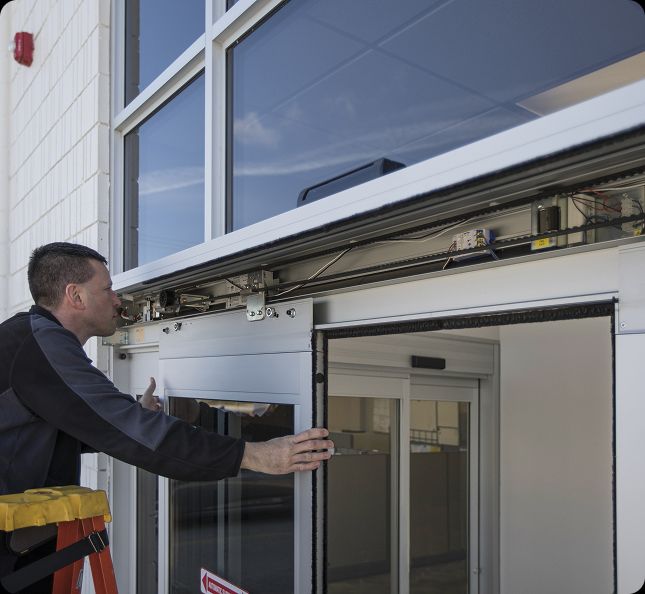
Low-energy swing operators turn typical hinge doors into touchless exits. They run under ANSI A156.19. They move more slowly than high-energy doors and rely on motion sensors, wave-to-open switches, and guard rails to protect the path of door travel. A wave-to-open switch is a no-touch button that triggers the operator with a hand wave. Low-energy swing operators fit well on single-leaf doors in medical offices, banks, restaurants, and office suites. They often reuse the existing aluminum storefront door, the closer, and the frame, which keeps costs down compared to a full-frame replacement.
Buffalo storefront systems and operators that play well together
Cheektowaga’s commercial stock spans mid-century strip plazas, modern big-box, and medical offices. Many carry Kawneer Trifab 400 and 450 series frames, Tubelite T14000 and T24000, YKK AP YES 45 and YES 60, and legacy Vistawall and US Aluminum storefronts. The doors are often narrow stile, which means a 2-1/8 inch vertical rail, or medium stile at 3-1/2 inches. Narrow stile aluminum doors use offset pivot hinges instead of side butt hinges. An offset pivot hinge is a top and bottom pin set that carries door weight at the floor and head so the door rotates smoothly. The bottom pivot bearing sits close to the threshold where road salt and meltwater collect. It is the first point to seize in winter. On taller doors, an intermediate pivot supports the stile mid-height to reduce flex.
Automatic swing operators from Record USA, Horton, Stanley, and Besam ASSA ABLOY mount well to these storefront frames when supported by reinforcement plates and a correctly sized closer arm. Record USA units pair with BEA or Optex sensors for approach and safety zones. For sliding doors, Record USA Series 8000 and equivalent products from other brands use a header track, motor, and belt to move panels. Presence sensors watch the threshold to keep the panel from closing on a person. With AAADM-certified setup and sensor alignment, these systems integrate safely with common storefront configurations across Cheektowaga, West Seneca, Amherst, and Depew.
Health, safety, and compliance drivers
Touchless egress reduces hand contact on door hardware. In healthcare and food service facilities near the 14225 and 14221 corridors, that is now a baseline expectation. Low-energy operators reduce door-force noncompliance during Buffalo cold snaps. For life safety, the critical standards are ANSI A156.10 for sliding doors, ANSI A156.19 for low-energy swing operators, AAADM inspection labeling for automatic doors, NFPA 101 for egress, and IBC Chapter 10 for means of egress. In occupied commercial buildings, doors used for exit paths must be free of special knowledge to open and cannot present obstruction. Automatic doors must fail safe. That means if power goes out, the door can be opened manually and locks release along the egress path. In healthcare, sensor coverage and approach speeds are tuned carefully to accommodate wheelchairs and walkers without creating door strikes. These details need field experience. A technician sets sweep speed, latch speed, and backcheck on any existing hydraulic closer so the operator does not fight the closer and the door closes fully to latch.
Weather, vestibules, and energy in the Buffalo metro
Cheektowaga businesses often use vestibules to hold heat in winter and cut wind tunneling. Sliding doors reduce stack effect, which is the pressure difference that drives air flow through a warm building when it is cold outside. When a swing door opens into a wind gust, it can take longer to close. It also rattles the latch and puts extra strain on the closer. A sliding door in a vestibule removes that lever effect and cycles more consistently during a storm. In many strip plazas near Union Road or French Road, a low-energy swing operator on the interior vestibule door paired with a manual or automatic exterior door keeps traffic smooth in cold weather while controlling drafts. Each site needs field evaluation to pick the right pair and sensor layout.
Failure patterns A-24 Hour Door sees on automatic egress in WNY
Wind and salt shorten life for sensors, pivots, and thresholds. Presence sensors sometimes drift out of aim, which creates nuisance holds or slow response. Floor areas under sliding thresholds collect grit that wears rollers. On swing systems, older hydraulic closers leak oil once seals harden. That is often visible as dark streaks down the door. Oil loss means the arm no longer controls the door. The door may slam or fail to latch, which is a code issue and a customer-safety problem. Bottom pivot bearings in aluminum doors fail early in Buffalo because meltwater and salt reach the pivot pocket. Bearings seize and the door sags. When a door sags, the lock no longer lines up and the door drags the threshold. A sagging door also stresses an automatic operator. The operator senses extra load and may fault or overheat. That drives emergency calls during business hours.
Automatic sliding door repair and low-energy operator service in practice
Automatic sliding door repair starts with safety lock-out, sensor verification, and roller and belt inspection. A sensor alignment is a small adjustment to the aim and range of the sensors so they trigger only when a person is in the target zone. On a slide, the motor belt, rollers, and track must be clean and intact. The control board records fault codes that guide testing. For low-energy swing operators, the technician immediate commercial door repair verifies approach and safety sensors, inspects the closer for leaks, checks door balance, and sets opening and closing speeds to A156.19. On aluminum storefront doors, the operator often shares duty with a surface-mounted hydraulic closer. The closer sets the final closing force and latch engagement. The operator does the work to open and controls the closing cycle rate. Both must be in good shape.
Cheektowaga facility types where touchless egress pays off fastest
Pharmacies with high prescription pickup traffic, grocery and convenience corridors, quick-serve restaurants with tight seating, medical clinics, and bank branches see the fastest gains. These locations feel the winter closer drag most and have a higher ADA exposure with seniors, strollers, carts, and mobility devices. Big-box retail on Transit Road and Genesee Street sees high wind loads on large doors. Logistics offices around KBUF run 24 hours and need reliable egress during late-night shifts. Touchless egress reduces late-night safety calls from jammed manual doors. It also reduces the after-hours commercial door repair burden due to slammed closers and failed pivots. Measured over a winter, fewer emergency calls and smoother entries offset the initial commercial door installation cost.
A Buffalo-specific maintenance window that protects touchless systems
Fall pre-winter service is the best time to check automatic doors in Erie County. Cold thickens closer fluid and shows weak seals. Sensors lose performance when lenses have film from summer construction dust or nearby parking lot resurfacing. Threshold brushes hold grit that binds rollers. A technician cleans sensors, re-aims presence coverage, replaces cracked weatherstripping, and verifies latch. On swing systems, the closer’s sweep and latch speeds are tuned for winter conditions. In many Buffalo sites, this visit in September or October prevents the holiday-run failures that drive costly emergency calls in December and January.
Hardware and brand familiarity that keeps jobs on schedule
Commercial storefront frames across Cheektowaga often use Kawneer 190 narrow stile and medium stile doors with offset pivots, Tubelite stiles, YKK AP frames, and legacy Vistawall or US Aluminum installations. Touchless conversions and service succeed when the contractor knows the hardware stack. That means understanding the pivot system, the closer, the lock, and the sensor package. Common closer models across Buffalo include LCN 4040 and 4110 series, Norton 1600 and 8000 series, Dorma RTS88 concealed overhead closers, and Sargent 281 and 351 series. On the lock side, a narrow stile deadlatch, like the Adams Rite 4510, or an MS1850 series deadbolt shows up on many doors. Exit devices such as the Von Duprin 98 or 99 series stand at rear egress doors. A technician must verify that any power operator does not defeat the fire and life safety function of panic hardware and that electric strikes release on egress.
Sensor layout and door zone strategy for Buffalo winters
Snow piles, wind gusts, and salt spray complicate sensor placement. A presence sensor that faces a parking lot entrance may false-trigger when blowing snow crosses the field. A well-aimed sensor with a reduced range and a tighter field pattern solves it. On sliding doors near vestibules, mounting height and sidelites affect beam placement. A sidelites is the fixed glass panel next to a door. Reflective low-E coatings, which are thin metallic layers applied to glass to reduce energy loss, can cause beam bounce. An experienced installer accounts for reflections and sets the beams to ignore the glass. On swing operators, wave-to-open plates are positioned to avoid accidental triggers by carts while still meeting ADA approach needs. The details keep the door from standing open during a storm and freezing the vestibule.
How touchless egress interacts with access control
Many Cheektowaga properties use card readers, which are small electronic devices that read access cards, at staff doors. An automatic operator must coordinate with electric locks. An electromagnetic lock is a device that holds a door with a magnet until power is cut. On egress, the lock must release without special knowledge or effort. In most cases, that means a request-to-exit sensor and a push-to-exit button wired in series with the fire alarm. On sliding doors, the break-out function must remain available. On swing doors, the operator and the closer must allow push-through if the operator fails. AAADM labeling confirms the door passed a functional safety test. In medical locations governed by stricter codes, the installer coordinates with the life safety consultant to confirm NFPA 101 and local enforcement at the City of Buffalo Department of Permit and Inspection Services align with the setup.
Automatic doors and cold-weather reliability
Automatic operators draw steady power and perform better in cold than a worn manual closer. Still, Buffalo winters test any mechanism. Belt materials in sliders stiffen. Grease on rollers thickens. Door sweeps drag on ice pellets. A winter-ready setup uses lubricant rated for low temperatures, correct clearances at thresholds, and positive latching. For swing doors, a closer set for winter latch speed will close and latch even against a vestibule pressure difference. The operator’s closing torque setting must be matched to the closer so the closer, not the motor, provides final latching force. That protects the operator gearbox and extends life.
What Cheektowaga managers ask about costs and schedules
General market experience across Buffalo shows that converting a single storefront door to a low-energy operator is usually far less expensive than replacing the entire aluminum door and frame. Exact numbers depend on brand, door size, power availability, and sensor package. Sliding door projects add header, track, and glass panel work. A site visit confirms electrical supply, frame reinforcement, and any glazing changes. Many service calls finish same day when the contractor runs stocked trucks. A diagnosis visit for automatic sliding door repair often ends with a belt replacement, sensor realignment, or control board swap if inventory matches. When glass or custom hardware is needed, a temporary board-up or safe manual mode holds the entry until OEM parts arrive. The fastest route is a contractor with OEM parts access and factory familiarity across Record USA and the major storefront brands found in Western New York.
A locally shareable insight for Cheektowaga and Buffalo facility teams
Buffalo’s winter drives a specific failure pattern. Below roughly 20°F, hydraulic closer fluid thickens and loses damping consistency. Doors become harder to open and more likely to slam. On busy corridors like Main Street in Williamsville, Elmwood Avenue, and Hertel Avenue, that change hits the highest-failure-rate component on the storefront. Scheduling a fall pre-winter check in September or October delivers the highest return on investment of any commercial door service visit in the Buffalo calendar. It cuts emergency calls during holiday rushes and keeps touchless doors within ANSI and ADA spec through the coldest months.
Where touchless egress unlocks operations across WNY
In 14225 Cheektowaga, emergency commercial door repair automatic sliding doors at pharmacies and groceries push more customers through the vestibule per minute without door collisions. In 14204 near Downtown Buffalo, low-energy operators on office suites reduce ADA complaints in older buildings retrofitted with aluminum storefronts. In 14150 Tonawanda and 14228 Amherst, lab and light industrial sites near the I-290 favor touchless swing operators on interior fire doors paired with compliant closers so egress stays clear while hands carry materials. In 14075 Hamburg and 14127 Orchard Park, restaurants see fewer winter slips at the threshold because the door opens on approach rather than from a shove that throws weight forward on ice. In the Buffalo Niagara Medical Campus around 14203, AAADM-inspected sliding entries handle high cycle counts while still passing annual life safety checks.
Signs a property should move now on touchless egress
The best time to switch is right after repeated complaints about door force or before the holiday season. Other flags include oil on the door or floor from a leaking closer, a sagging aluminum door that drags the threshold, repeated wind hold-opens on a swing entry during storms, or a lobby that overheats in summer and freezes in winter because the manual door stands open. If emergency board-ups from broken glass or forced entries have interrupted operations, sliding doors with break-out panels and upgraded tempered or laminated safety glass reduce both disruption and repair costs during future incidents.
Touchless egress and storefront glass choices
Most storefronts in Cheektowaga use tempered glass per ASTM C1048. Tempered glass is heat-treated so it breaks into small pieces, not sharp shards. Some healthcare and higher security sites choose laminated safety glass per ASTM C1172. Laminated glass bonds two pieces of glass with a plastic layer so it stays in the frame if broken. Insulated glass units per ASTM E2190 cut heat loss in winter and reduce condensation. For sliding doors, a clean track and solid threshold keep insulated units gliding smoothly. For swing doors, a weatherstripped meeting stile, which is the vertical join where a pair of doors meets, reduces winter drafts while staying within the 3/4 inch undercut and 1/8 inch gap tolerances that govern fire-rated doors if the opening is rated.
Inventory that shortens downtime during automatic door service
Repair speed depends on what is on the truck. Stocking common swing operators, approach sensors, safety beams, LCN and Norton closers, Adams Rite locks, Von Duprin exit devices, BEA and Optex sensors, and tempered glass blanks in standard sizes allows same-day fixes for many issues. For aluminum storefronts, carrying pivot hinge sets such as a Kawneer-style offset pivot and intermediate pivot prevents second trips when a sagging door is found during a touchless conversion. For sliding doors, belts and rollers for major brands and emergency board-up materials allow safe overnight operation while waiting on custom glass or specialty components.
Why Cheektowaga businesses choose local automatic door experts
Out-of-town installers often misread Buffalo’s winter. They set door speeds and sensor ranges for milder markets. Then the first lake-effect event pushes doors open, throws off sensors, and the calls begin. A local commercial door team knows that vestibules catch grit and salt, that thresholds corrode early, and that wind fetch from Lake Erie can add real forces to door panels. They also know the storefront brands common in this region and keep parts on trucks that match those systems. In Cheektowaga and the Niagara Frontier, that local pattern knowledge turns into fewer re-visits, lower seasonal energy losses, and cleaner inspections.
Response model and coverage for automatic egress issues
For late-night faults on automatic sliders near KBUF or weekend jams at retail plazas in 14225, fast response keeps staff moving and reduces losses. A direct-dispatch model from Buffalo’s 14204 corridor keeps travel time short. With 24/7 emergency service, a technician can secure a door, board up if glass breaks, or return a door to safe manual mode. Many calls end with a single-visit fix when the truck carries the right operator, closer, belt, rollers, pivots, and sensors. When OEM parts are needed, clear communication and a temporary safe configuration keep the site open.
Who to call for touchless egress doors in Cheektowaga and across Buffalo
A-24 Hour Door National Inc. Is a Buffalo-based commercial door contractor at 344 Sycamore Street, Buffalo, NY 14204. The team serves Cheektowaga, West Seneca, Amherst, Williamsville, Tonawanda, North Tonawanda, Hamburg, Orchard Park, Depew, Lancaster, and the wider Western New York corridor. The company runs 24/7 emergency dispatch and fields AAADM-certified technicians for automatic door work. They are an authorized service partner for Record brand entrance solutions and handle automatic sliding door repair, low-energy swing operators, and sensor alignment in compliance with ANSI A156.10 and A156.19. Service trucks are stocked for single-trip repair with common pivot hinges, LCN and Norton closers, Adams Rite hardware, BEA and Optex sensors, and board-up materials. OEM parts carry manufacturer warranties, and service is backed by a satisfaction guarantee. The company has more than 30 years in the commercial door market and works daily with storefront systems from Kawneer, Tubelite, YKK AP, Vistawall, US Aluminum, and Ellison Bronze. They also provide Hormann commercial garage door authorized service for warehouse and dock doors.
For a touchless egress assessment, automatic sliding door repair, or a low-energy operator upgrade in Cheektowaga 14225 or anywhere in Erie County, call A-24 Hour Door National Inc. At (716) 894-2000 or the national line at (800) 884-4440. Same-day emergency response is available. Flexible payment options include Cash, Check, Mastercard, Visa, American Express, and Net 30 for qualified customers. Verified on-the-ground service from a Buffalo team that knows lake-effect winters, local storefront brands, and busy retail corridors keeps doors moving and people safe. The Google Business Profile reflects a 4.8 rating from 59 Google reviews at the time of writing. For scheduling or information, visit https://a24hour.biz/buffalo/.
At-a-glance reasons to move to touchless egress now
- Reduces door force issues during Buffalo winters and helps meet ADA expectations.
- Cuts contact points for hygiene in pharmacies, clinics, and restaurants.
- Improves traffic flow in tight vestibules on Walden Avenue, Transit Road, and Genesee Street.
- Lowers after-hours emergency calls caused by slammed closers and sagging pivots.
- Supports egress compliance under ANSI A156.10, ANSI A156.19, and NFPA 101 with AAADM-certified service.
Related commercial door services available from the same Buffalo team
A-24 Hour Door National Inc. Also supports wider business door repair needs. That includes commercial door repair on manual entries, storefront glass replacement with tempered or laminated safety glass, exit device repair on Von Duprin hardware, dock and overhead door service including Hormann commercial garage doors, and commercial door installation for expansions and remodels across Western New York. One contractor that understands the whole opening reduces coordination time and speeds inspections.